Number of instruments needed? Really not very many at all!
Indian classical music generally uses around two or three instruments, one of which is no more than a drone; so essentially it’s duos – Sitar or Sarod, with Tablas, sometimes with voice as well; it has served them well for over 1,000 years.
This ‘chamber’ approach is common across the world in both art and vernacular music.
However, over the last 500 years we in the West have swollen our musician ranks from a humble solo lute to insanely large orchestras, choirs (& both together) culminating in the gargantuan forces of Mahler, Havergal Brian, Schoenberg, et al., which I feel has added little or nothing of musical value.
Here’s a note from the School of the Bleedin’ Obvious: “Lots of people playing together has no bearing whatsoever on the quality of the music.”
Hearing large-scale forces in a live context (or via recording on a good system) can be a very powerful experience, but as Stokowski proved with his Bach arrangements adds nothing at all to musical potency – much as I enjoy those Stokowski things myself – I far prefer to hear Ralph Kirkpatrick playing solo harpsichord any day.
I write a lot of duos, some 170 at the last count – here’s one:
They usually consisting of a melodic instrument such as violin, horn or clarinet (or voice for songs) together with a harmonic one such as guitar, piano, or mandolin (the latter in this video taking the melodic role).
When I was younger, the trendy thing was to write for ‘ensemble’ of 10-16 players, something which gave a timbre range that mimics an orchestra but with less cost and a chamber approach to performance.
However, this was only possible if you were fortunate enough to be commissioned while still a student or by taking part in that diabolical and entirely pointless piece destructor the ‘Workshop’.
Workshops are enough to make you doubt yourself, and unfairly – it is the lack of focus (it not being aimed at a concert/recording) that would make your work appear to fail; which turned out to be inaccurate – almost always.
It makes far more sense to me, given the considerable amount of music I write – and the speed at which I do so – to keep forces to a minimum and hear the results of all I do; especially to hear it in the ideal context of recording, where one knows that any failing is in the work itself and not its performance – regarding the latter, one can now attain performance perfection in the studio.
This way I learn what is most potent from my various techniques and happily discard those that don’t deliver.
This is how I continue to learn and improve – through empirical trial – music is after all a craft & sometimes can be an art form, in the right hands.
This approach must be backed up with knowledge gleaned from score study and instrumental mastery (absolutely essential) but most importantly – from listening (repeatedly and intensely) to the best music ever written.
Putting aside my own development – the musical value of using few instruments are many:
Clarity of intent: when you have just two instruments you can hear everything. There is no room for padding or dressing up some tedious atonal mush behind fashionable orchestration (you know who you are: go and stand in the corner with a book of Bach chorales!).
The interaction between the players is very strong – each person has just one relationship, i.e. they can give the other player their full attention without having to interact with anyone else.
The flexibility in performance is as free as one gets with just one player. You can write any rhythmic pattern you want and change it in a nanosecond if so desired – two players will get it, and can do it, quite easily in my experience.
There is no timbral distraction. For example, a viola/guitar duo clearly has some colour difference between, and within the instruments, but not enough to serve as a structural delineator as one would find in a classical period symphony. This means that you’d better then find another way to mark off sections or phrases. As is SO often the case – a restriction causes you to stretch your mind and find new solutions.
Compositional process:
The way I compose is simple:
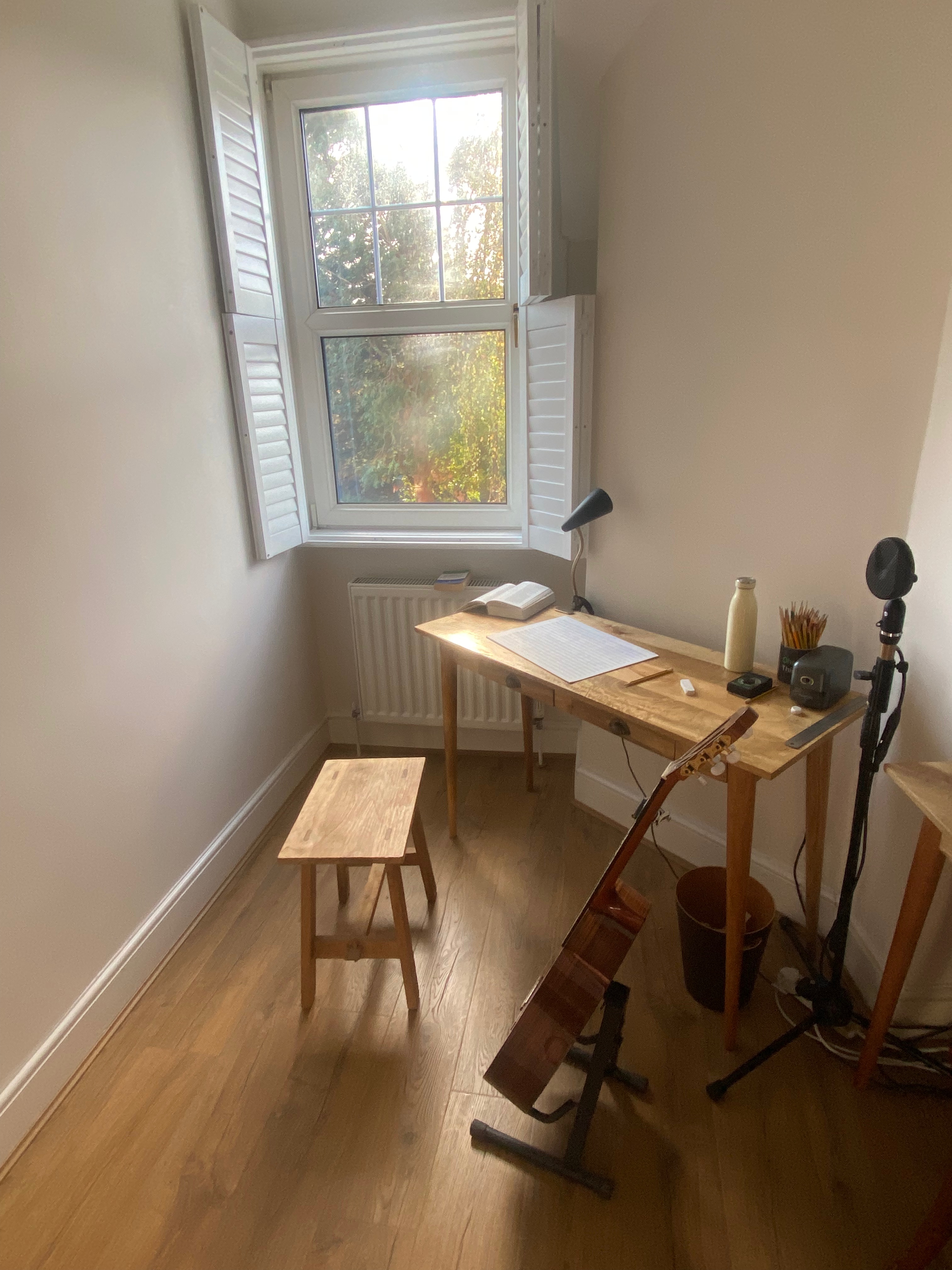
Ingredients required: pencil, paper, guitar (or piano)
I pick up a guitar (or occasionally use the piano) and find a random interval, chord or three-note tune.
I then stop and listen in my mind
I hear an internal ‘recording’ of what comes next
I write that down
I then play from the start to the end of where I am
I then stop and listen again
I hear the ‘mind recording’
I write that down
I keep doing this until the music says unambiguously – “this is the end of the piece” – to not obey is ALWAYS a mistake.
I get my ruler and write a double bar line, sign, date and dedicate the work.
I do not, and NEVER will, use a computer when composing – it is the most powerful imagination killer known to mankind.
When I was younger this process was far more difficult as my inner ‘recording’ was unclear and often extremely wonky.
So look, if you are a young or less-experienced composer, please do not lose heart if you have trouble hearing in your mind. Keep listening and give it time. You have time – but ONLY if you make the time by giving up other things.
I have been doing this, or some form of it, since 1979 when I wrote my first pop song – it gets easier, a lot easier which, like mastering an instrument, allows you to then try all kinds of new challenging things.
Hope you’ve enjoyed my first blog.
David Braid
December 2024
 DAVID BRAID